Glass Jar Manufacturing Process
The modern glass jar manufacturing process is a marvel of precision engineering, transforming raw earth minerals into the crystal-clear containers you see on store shelves. While glass making has ancient roots, today’s mass production relies on automated machinery to ensure every jar is uniform, durable, and safe for consumer use.
Overview of the Production Cycle
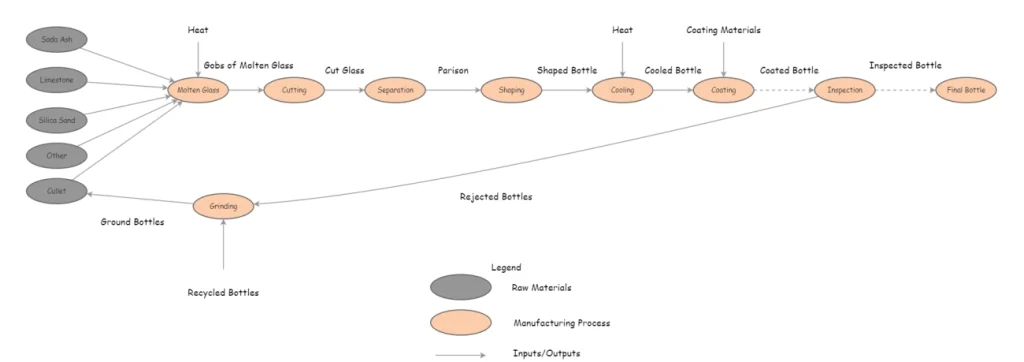
The lifecycle of a glass container moves through several distinct phases:
- Batching: Mixing raw materials.
- Melting: Liquifying the mix in a high-heat furnace.
- Forming: Shaping the molten glass using specialized molds.
- Annealing: Controlled cooling to ensure structural integrity.
- Inspection: Rigorous quality checks for defects.
Why Brands Choose Glass Packaging
Glass remains a premium choice for global brands due to its unique properties:
- Impermeability: It does not react with chemicals or alter the flavor of food and beverages.
- Sustainability: Glass is 100% recyclable and can be reused indefinitely without loss in quality.
- Aesthetics: It offers a high-end look and feel that plastic cannot replicate.
Step 1: Raw Material Preparation and Batching
Before the heat is turned on, the “recipe” for the glass must be perfected. This stage ensures the final product has the desired clarity and strength.
Essential Ingredients for Glass Making
Most commercial glass jars are “soda-lime-silica” glass, consisting of:
- Silica Sand: The primary structural component.
- Soda Ash: Lowers the melting temperature of the silica.
- Limestone: Acts as a stabilizer to make the glass durable and water-resistant.
The Crucial Role of Recycled Glass (Cullet)
Manufacturers integrate cullet (crushed recycled glass) into the batch. Using cullet is highly efficient because it melts at a lower temperature than raw minerals, significantly reducing energy consumption and carbon emissions during the glass jar manufacturing process.
Mixing and Weighing the Batch
Precision is vital. All ingredients are weighed electronically and mixed thoroughly to create a “batch.” This ensures that the chemical composition is consistent before it enters the furnace.
Step 2: Melting the Glass in the Furnace
Once the batch is ready, it is subjected to extreme thermal energy to transform solid grains into a workable liquid.
Feeding the Raw Materials
The mixed batch is fed continuously into a massive glass furnace. These furnaces operate 24/7 to maintain the thermal equilibrium required for high-volume production.
Heating to Extreme Temperatures
Inside the furnace, temperatures reach upwards of 2,700°F (1,500°C). This intense heat causes the raw materials to chemically react and fuse into a glowing, molten state.
Achieving the Ideal Molten State
The glass must be free of bubbles and impurities. As it flows toward the refining end of the furnace, the temperature is slightly lowered to reach the perfect viscosity for shaping.
Step 3: Forming the Glass Jars (The Hot End)
This is where the liquid glass takes its physical form. The process happens in seconds to prevent the glass from cooling too quickly.
Cutting the Molten Glass (The Gob)
A shearing blade cuts the molten glass into precise, cylindrical weights called a glass gob. Each gob contains exactly enough material to form one jar or bottle.
The Blow and Blow Process
Used primarily for narrow-neck containers, this method uses compressed air to form the “finish” (the neck) and then blows the glass into its final shape within a mold.
The Press and Blow Process
This is the standard for wide-mouth jars.
- The Plunger: A metal plunger presses the gob into a blank mold to create a parison (a partially formed jar).
- The Final Blow: The parison is transferred to a blow mold, where compressed air expands it into the final container shape.
| Feature | Blow and Blow | Press and Blow |
|---|---|---|
| Best For | Narrow-neck bottles | Wide-mouth jars |
| Primary Tool | Compressed Air | Metal Plunger |
| Key Advantage | Uniform neck thickness | Better control of glass distribution |
Step 4: The Annealing Lehr Process
Rapid cooling causes internal stress that makes glass brittle. To prevent shattering, the jars undergo a heat-treatment process.
Entering the Cooling Chamber
The freshly formed jars enter an annealing lehr, a long, temperature-controlled oven.
Relieving Internal Glass Stress
The jars are reheated to a point where internal stresses are relieved, then cooled very slowly. This “soaking” period ensures the glass structure is stable.
Preventing Thermal Shock and Breakage
Properly annealed glass can withstand temperature fluctuations and mechanical impacts. Without this step, a jar might explode or crack the moment it is filled with a hot product or bumped during shipping.
Step 5: Inspection and Quality Control (The Cold End)
Quality is non-negotiable. Every jar is scrutinized before it leaves the facility.
Automated Electronic Testing
High-speed cameras and sensors inspect jars for:
- Wall thickness variations.
- Dimensional accuracy.
- Cracks or “checks” in the glass.
Visual Inspection for Flaws and Defects
Trained technicians perform spot checks to identify cosmetic flaws like “stones” (unmelted batch particles) or bubbles that automated systems might miss.
Rejecting and Recycling Imperfect Jars
Any jar that fails inspection is immediately rejected. These rejects are crushed back into cullet and sent back to the furnace, ensuring zero waste in the production loop.
Step 6: Final Packaging and Distribution
The final stage ensures the jars reach the customer in pristine condition.
Sterilization and Surface Treatment
Jars often receive a thin exterior coating to prevent scratching when they rub against each other on conveyor belts.
Palletizing the Finished Jars
Automated arms stack the jars onto pallets with protective layers between them. The entire pallet is then shrink-wrapped for stability.
Preparing for Safe Shipping
The pallets are staged for transport, ready to be shipped to brands worldwide for filling with spices, sauces, or cosmetics.
FAQs
What is a “gob” in glass making?
A gob is a specific, measured weight of molten glass cut by a shearing blade, which eventually becomes a single jar.
What is the difference between a blank mold and a blow mold?
The blank mold creates the initial shape (parison), while the blow mold gives the jar its final dimensions and design details.
Is all glass recyclable?
Yes, the glass used in jars and bottles is 100% recyclable and is a primary ingredient (cullet) in creating new containers.